25/02/2026 | News, Blogs
Within the MULTICLIMACT project an interoperable framework was developed based on the SCPS/SCP standards to integrate heterogeneous urban data, including seismic, environmental, infrastructural, and physiological sources for enhanced monitoring, risk assessment, and resilience decision-making. It was demonstrated through a seismic risk case study in Camerino, Italy, which utilized multiple digital solutions and a BIM-integrated LIS platform to provide a harmonized, scalable, and replicable environment supporting local authorities in managing natural hazards and urban health.
By Prof. Gloria Cosoli (UNI VPM), in cooperation with ENEA & LIS
Background
Traditionally, emergency management and risk monitoring have been fragmented processes. Data collected by various agencies (e.g., seismic monitoring, weather, infrastructural maps, and emergency services) often reside in isolated silos, making real-time assessment and coordinated response almost impossible. To make prompt and effective decisions, administrators require interoperable platforms and tools that harmonize data flows and facilitate seamless communication among digital systems. In this context, the MULTICLIMACT project (G.A. n. 101123538) has developed an interoperable and multipurpose framework to enhance urban smartness and sustainability, and to support and improve resilience in municipal decision-making. The framework connects heterogeneous data sources, from core infrastructures and buildings to environmental and even social systems, enabling them to operate as they were part of a unified environment. This integration includes cutting-edge elements like physiological monitoring via wearable sensors and precise microclimate recording, ensuring a truly comprehensive picture of urban health and risks.
The approach: interoperability with SCPS/SCP
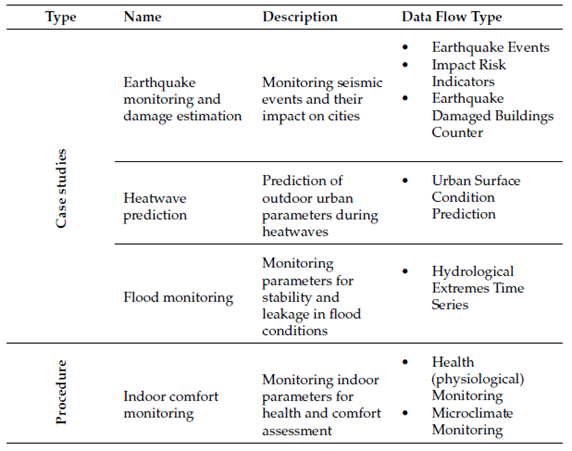
The interoperable framework has been designed starting from a reference scenario (Table 1) that includes several vertical case studies and a cross-cutting procedure with a two-fold goal: to monitor, detect, and respond to critical conditions related to natural hazards, and simultaneously to monitor the health and well-being of individuals in affected areas.
It is based on the SCPS (Smart City Platform Specifications for interoperability layer) and its reference implementation, the software prototype SCP (Smart City Platform), both developed by ENEA.

A set of public specifications that defines a common language and a shared protocol for communication among heterogeneous solutions, recommended in the Italian national standard UNI 11973:2025.
A software platform to retrieve and harmonize data from various solutions operating at different urban scales.
SCPS and SCP ensure interoperability through two fundamental concepts:
The interoperable framework, which includes a syntactic and semantic data validation process, allows the framework to be scalable (new scenarios and systems can be added) and replicable across different urban contexts.
Field test: The Italian Pilot in Camerino
The approach has been implemented and tested in the municipality of Camerino, a city with significant experience in managing seismic risk and test site of the MULTICLIMACT Italian pilot, where a case study has been developed focusing on the seismic risk associated with the Visso earthquake on October 2016, simulating its effects on buildings, infrastructure, and indoor comfort.
The case study has involved three digital solution developed within MULTICLIMACT (Figure 1):
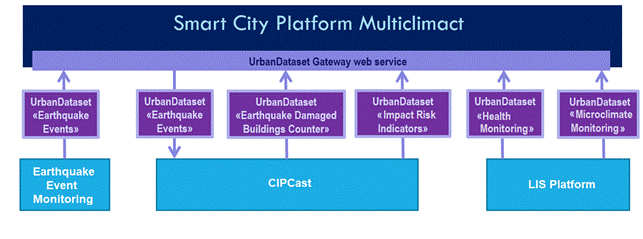
Figure 1. Architecture implemented in the Italian pilot
(i) Earthquake Event Monitoring, designed to collect and process earthquake related data from external source
(ii) CIPCast Decision Support System, which supports risk assessment for buildings and infrastructures and evaluates urban resilience with respect to specific natural events
(iii) LIS platform, designed as a multi-domain monitoring system that integrates environmental and physiological data collection within buildings
The LIS Platform with Building Information Modeling (BIM)
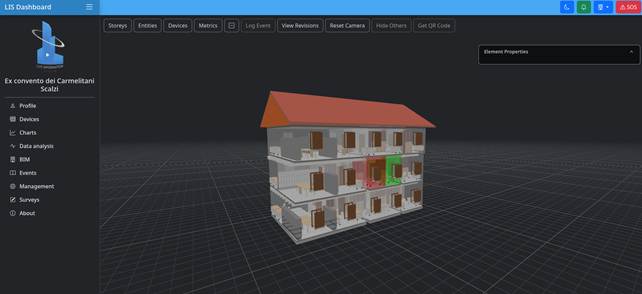
The LIS Platform, designed as a multi-domain monitoring system, is characterized by native integration with Building Information Modeling (BIM), which provides a spatially aware and semantically rich foundation for data visualization, contextual analysis, and predictive modelling. The platform interfaces directly with the building’s digital model (typically in IFC format), ensuring interoperability across BIM tools and a consistent mapping between sensor data and building elements.
Environmental and physiological sensors are registered with spatial metadata and linked to specific IFC entities, enabling semantic enrichment of time-series data with architectural context. This integration converts the BIM model into a live digital twin that dynamically represents the building’s operational state, including indoor environmental quality, energy performance, and human-centered comfort indicators (Figure 2).
Figure 2. Italian Pilot Site: Carmelitane Building – LIS Platform Dashboard
The Smart City Platform
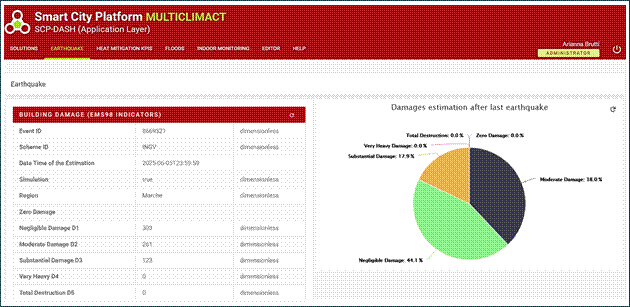
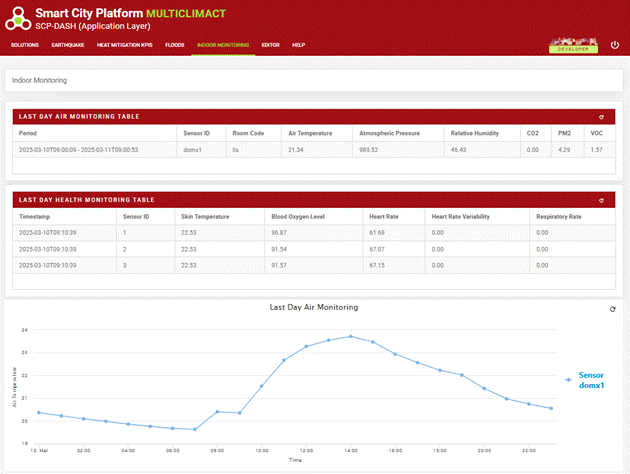
The case study has demonstrated the feasibility of having data from different solutions in a harmonized environment (Figure 3;4), and how this provides several strategic advantages and supports local decision-makers during and after seismic events, enhancing situational awareness and enabling more informed and timely responses. Further details related to the proposed framework are available in the scientific publication available at https://www.mdpi.com/2071-1050/17/22/9960.
About MULTICLIMACT:
MULTICLIMACT is an EU-funded project aimed at safeguarding Europe’s built environment against the increasing threats of natural and climatic hazards. By uniting 25 leading European organisations, MULTICLIMACT aims to enhance resilience, sustainability, and safety for communities across the continent. Through innovative strategies, including a toolkit of 20 reliable methods and digital solutions, the project targets the urgent need for adaptive measures against floods, earthquakes, extreme weather conditions and heatwaves. Tested across four pilot sites with diverse climatic conditions, MULTICLIMACT embodies a shared vision for a safer, more resilient future, focusing on actions to reduce the impact of climate change on the built environment. For more information, please visit www.multiclimact.eu.


MULTICLIMACT is a Horizon Europe project supported by the European Commission under grant agreement No 101123538. Views and opinions expressed are however those of the author(s) only and do not necessarily reflect those of the European Union. Neither the European Union nor the granting authority can be held responsible for them.
© 2026 MULTICLIMACT Consortium Partners. All rights reserved.