02/10/2025 | News
A new Joint Research Centre report explains, in practical terms, how Europe can update structural design standards so buildings and infrastructure stay safe and functional in a changing climate.
By Steinbeis Europa Zentrum
When the climate changes, “normal conditions” no longer exist
Across Europe, the built environment is increasingly exposed to climate-related hazards that can affect both structural safety and everyday functionality. The European Commission’s Joint Research Centre (JRC) has now published a technical report that tackles a question many cities and engineers are grappling with: how do we make sure design rules reflect tomorrow’s climate, not yesterday’s?
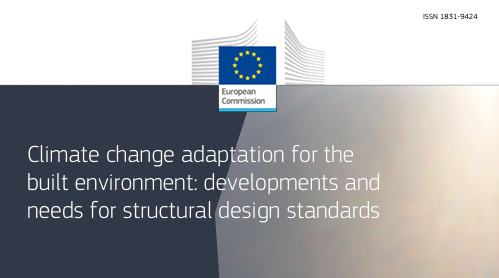
The report, published on 26 September 2025, is titled Climate change adaptation for the built environment: developments and needs for structural design standards (JRC143275) and it focuses on what needs to evolve in structural standards and the Eurocodes so climate adaptation becomes a consistent part of everyday practice.
This JRC report looks at how climate-related hazards influence the built environment and then translates that into what standards need to do differently, from the data they rely on to the methods used to set design values.
A central theme is the need to move from “we know the risk is growing” to “here is how design parameters should be updated.” That includes better ways to create and update “climatic action maps,” the technical maps that provide design values used in structural engineering for climatic actions such as temperature effects and snow loads.
Why harmonised climate data matters more than most people think
One of the biggest barriers to climate-smart design is not a lack of climate science, but the difficulty of using it consistently. The report therefore puts strong emphasis on harmonising climate data and defining protocols that make future mapping comparable across countries and over time.
It explicitly discusses climate change scenarios, uncertainties in climate projections, and the role of post-processing techniques such as bias adjustment. The message is not that uncertainty prevents action, but that standards need shared methods for handling it so updates are robust and transparent.
To keep the report grounded, the JRC includes case studies and applications that show how climate information can become design-relevant guidance. The table of contents points to examples on climate change impacts on corrosion risks in reinforced concrete building stock, as well as work on developing snow-load and thermal action maps in selected EU countries such as Portugal, Germany and Italy. These examples matter because they demonstrate the “translation step” that is often missing: moving from climate datasets and projections to the parameters that engineers, asset owners and authorities can actually apply in assessment, retrofit, and new design.
Why this is relevant for MULTICLIMACT
MULTICLIMACT is dedicated to safeguarding Europe’s built environment against increasing threats from natural and climatic hazards, working with innovative strategies tested across four pilot sites with diverse climatic conditions.
The JRC report complements this mission from the “standards and scaling” side. MULTICLIMACT develops and tests approaches and tools that support resilience in practice, while the JRC report clarifies what needs to evolve in the shared rulebook so climate adaptation becomes easier to mainstream across Europe. Together, they point in the same direction: resilience has to be multi-hazard, evidence-based and applicable across different scales, from individual buildings to neighbourhoods and wider systems.
More Information
If you work on building design, infrastructure, standardisation, or city resilience planning, this publication is a valuable reference point, especially if you are thinking about how climate projections should influence the parameters you rely on today.
Original source: JRC repository record (JRC143275) (JRC Publications Repository page)
About MULTICLIMACT:
MULTICLIMACT is an EU-funded project aimed at safeguarding Europe’s built environment against the increasing threats of natural and climatic hazards. By uniting 25 leading European organisations, MULTICLIMACT aims to enhance resilience, sustainability, and safety for communities across the continent. Through innovative strategies, including a toolkit of 20 reliable methods and digital solutions, the project targets the urgent need for adaptive measures against floods, earthquakes, extreme weather conditions and heatwaves. Tested across four pilot sites with diverse climatic conditions, MULTICLIMACT embodies a shared vision for a safer, more resilient future, focusing on actions to reduce the impact of climate change on the built environment. For more information, please visit www.multiclimact.eu


MULTICLIMACT is a Horizon Europe project supported by the European Commission under grant agreement No 101123538. Views and opinions expressed are however those of the author(s) only and do not necessarily reflect those of the European Union. Neither the European Union nor the granting authority can be held responsible for them.
© 2026 MULTICLIMACT Consortium Partners. All rights reserved.