05/11/2025 | News, Blogs
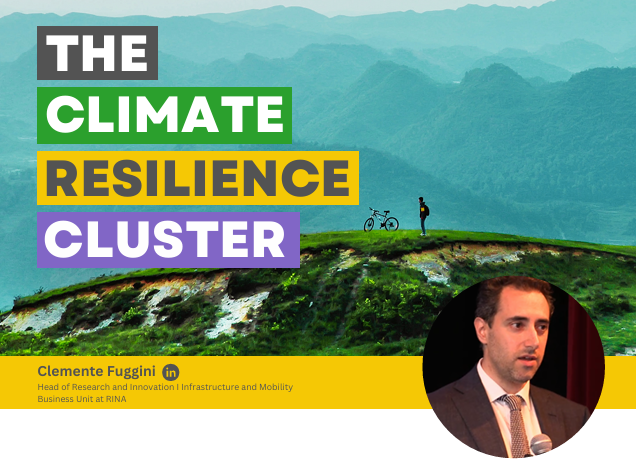
In a new opinion article for the Climate Resilience Cluster, Clemente Fuggini from RINA explains why resilience for the built environment must become a shared priority, and how MULTICLIMACT is helping cities turn that ambition into action.
By Steinbeis Europa Zentrum
What the Opinion Article Highlights
Climate related disruptions are becoming harder to ignore. From damaged infrastructure to interrupted services, the impacts are growing and so are the recovery costs for public authorities, communities and the private sector. In a newly published opinion article for the Climate Resilience Cluster, Clemente Fuggini, Head of Research and Innovation in the Infrastructure and Mobility area at RINA, argues that building resilience is not optional anymore. It is a responsibility and a shared vision for a liveable future. The article makes resilience easy to grasp by linking it to real life outcomes. It is not only about strengthening individual assets like roads, power lines, or water networks. It is also about keeping essential services reliable and reducing the consequences for people and local economies when disruptions happen. This perspective matters because cities function as interconnected systems, where a weak link can trigger wider knock on effects.
The Impact of Multiclimact
This is where MULTICLIMACT comes in. The article presents MULTICLIMACT as a research and innovation action designed to support cities and municipal authorities in understanding risks, building capacity, and measuring resilience across the systems they manage, from buildings to districts and whole urban areas. Instead of focusing only on risk in a fixed snapshot, the approach looks at today’s situation and future conditions across the life cycle of the built environment, helping decision makers think ahead rather than only reacting after damage occurs.
The opinion piece highlights the MULTICLIMACT Climate REsilience Maturity Assessment tool, known as CREMA. In simple terms, CREMA works like a resilience checkup, supporting decision makers with a structured way to understand current resilience and explore how different measures could strengthen preparedness and recovery over time.
Read the full article here:
Original author: Clemente Fuggini, RINA-C
About MULTICLIMACT:
MULTICLIMACT is an EU-funded project aimed at safeguarding Europe’s built environment against the increasing threats of natural and climatic hazards. By uniting 25 leading European organisations, MULTICLIMACT aims to enhance resilience, sustainability, and safety for communities across the continent. Through innovative strategies, including a toolkit of 20 reliable methods and digital solutions, the project targets the urgent need for adaptive measures against floods, earthquakes, extreme weather conditions and heatwaves. Tested across four pilot sites with diverse climatic conditions, MULTICLIMACT embodies a shared vision for a safer, more resilient future, focusing on actions to reduce the impact of climate change on the built environment. For more information, please visit www.multiclimact.eu.


MULTICLIMACT is a Horizon Europe project supported by the European Commission under grant agreement No 101123538. Views and opinions expressed are however those of the author(s) only and do not necessarily reflect those of the European Union. Neither the European Union nor the granting authority can be held responsible for them.
© 2026 MULTICLIMACT Consortium Partners. All rights reserved.