14/05/2026 | News, Blogs
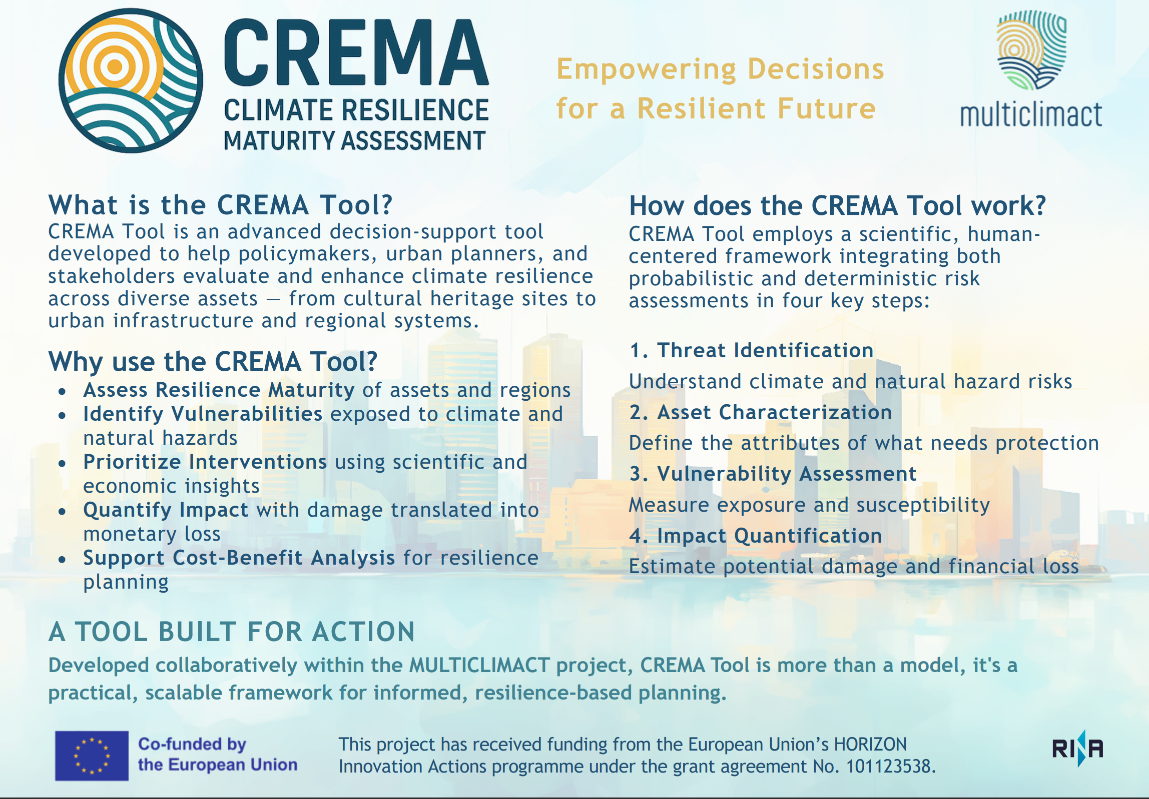
In our third interview, Celina Solari, MULTICLIMACT project coordination at RINA-C, presents the Climate Resilience Maturity Assessment (CREMA) tool together with Erika Palmieri from ICLEI and explains why developing it mattered, as it connects today’s current situation with future climate scenarios to make complex risk information easier to act on in real planning and management decisions. While both experts share the key messages in the interview, the story behind CREMA is a huge team effort shaped through co-creation, with stakeholders from different sectors helping refine the tool so it feels usable, transparent, and relevant for both technical experts and non-technical public officials.
The Climate Resilience Maturity Assessment tool, short ‘CREMA’, aims to help organisations manage climate and natural risks and has been developed by RINA-C. From your perspective, what key problem does it solve for planners, public authorities, or infrastructure managers?
Celina Solari (RINA-C):
Climatic risks are increasingly relevant, since intensity and occurrence of these events are likely to become more significant. However, assessing the maturity of systems, for instance assets, infrastructure, cities, or buildings against climate changes and climatic events projections it is not a trivial task per se. It involves the knowledge of both the current performance of the system (AS IS condition) under the pressure and stressor of climatic and extreme events, as well as the future projections (TO BE conditions) in light of emerging scenarios and a changing landscape. As recently pointed out by the Word Economic Forum (WEF), “failure to mitigate climate change”, “failure of climate-change adaptation” and “natural disasters and extreme weather events” are considered as the TOP 3 most impacting risks over a period of 10-years from now1. The CREMA tool addresses all of these risks and helps to mitigate their impacts. It can help organizations to think about actions that will have an immediate as well as mid- to long-term impact on how to mitigate the effects of climate-changes on the assets it owns or operates as well as on effective adaptation strategies.
ICLEI was responsible for the co-creation of the CREMA tool: Why did you choose a participatory, co‑creation approach for developing the CREMA tool?
Erika Palmieri (ICLEI):
We wanted to ensure its alignment with the practical requirements and operational realities of its intended users. Given the multifaceted nature of climate resilience, encompassing physical, social, and economic dimensions, a purely technical or top-down methodology risked producing a tool that was either overly complex or disconnected from the needs of practitioners and decision-makers. By engaging stakeholders from diverse sectors and governance levels, including public authorities, technical staff, NGOs, and community representatives, the development process prioritised real-world applicability, usability, and accessibility.
This collaborative framework enabled iterative refinement of the tool’s design, interface, and outputs based on direct feedback from end-users, thereby enhancing its clarity, functionality, and relevance. The co-creation methodology also fostered stakeholder ownership, as participants contributed to shaping a tool that reflected their specific challenges and priorities. This sense of ownership is critical for ensuring long-term adoption and sustained use in resilience planning and decision-making processes. Ultimately, the participatory approach transformed the CREMA tool from a theoretical framework into a practical, user-centred resource, capable of supporting evidence-based decision-making in the face of evolving climate risks.
How did the different co-development workshops contribute to shaping the CREMA tool?
Erika Palmieri (ICLEI):
We conducted a total of four co-development workshops where we progressed from foundational stakeholder alignment to operational usability testing. Each workshop targeted a distinct phase of development, ensuring iterative refinement based on targeted feedback.
Our stakeholder mapping workshop established the user base by identifying key stakeholder groups, their roles, and operational contexts, ensuring subsequent design phases accounted for diverse needs. After, the user experience and interface design workshop evaluated usability and interface clarity, with participants assessing user flow, terminology, and design coherence. Feedback led to refinements like adjusting professional terminology to better align with user expectations. During the third workshop we tested the clarity and relevance of tool outputs across different user profiles. Participants highlighted the need for clearer explanations and contextual support, particularly for users less familiar with resilience metrics or economic loss calculations. Finally, we shifted focus to end-to-end functionality testing, revealing operational friction points in scenario management while investigating the user journey and testing the tool’s usability. While users reported only 63% clarity rating for editing/deleting scenarios and 50% clarity rating for calculation steps , this workshop underscored the need for enhanced onboarding, workflow transparency, and contextual guidance to support independent use.
Across the workshops, what were the most consistent needs or challenges raised by stakeholders, and how did these shape the tool’s development?
Erika Palmieri (ICLEI):
Across the co-development workshops, three consistent needs and challenges emerged as recurring themes, each profoundly shaping the CREMA tool’s development:
From engaging such a diverse set of stakeholders, spanning local authorities and technical experts, the team learned that resilience tools must balance complexity with clarity. While technical experts sought granular control and customization, local authorities prioritised simplicity, accessibility, and actionable insights. This tension taught us a key lesson: co-creation isn’t just about collecting feedback, it’s about turning that feedback into features that work for everyone, without making the tool too simple or losing its strength.
Could you give an example where stakeholder input directly led to an improvement in the tool?
Celina Solari (RINA-C):
Stakeholder feedback played a crucial role in improving the user experience, particularly in how results are accessed and interpreted across different scenarios. One of the main aspects that benefited was the visualization and accessibility of outputs. Through the workshops, stakeholders helped us understand whether the results produced by the tool were not only technically correct, but also clear and actionable for decision-making. Their input led to improvements in how different scenarios are presented, making comparisons more intuitive and ensuring that key insights are immediately visible. More importantly, stakeholder feedback allowed us to validate whether the level of detail and type of outputs provided were sufficient to support real-world decisions. This iterative process ensured that the tool does not just generate data but delivers decision-relevant information tailored to user needs.
How does the tool accommodate very different user profiles, from highly technical experts to non-technical public officials?
Celina Solari (RINA-C):
The tool is designed to support two main user profiles: technical users and managerial, non-technical users. For technical users, the tool provides access to detailed parameters, modelling assumptions, and analytical outputs that allow for in-depth analysis and customization. For managerial or non-technical users, particular attention has been given to clarity and interpretability. Each parameter and component of the tool includes a dedicated description section, which explains its meaning, role, and implications in a simplified way. These descriptions can be configured on the administrative side during the setup of assets and pilot cases, ensuring that explanations are context-specific and user-friendly. This approach creates a bridge between complexity and usability: Technical robustness is preserved, while non-expert users are supported through clear explanations and guided interpretation, enabling them to confidently use the results in planning and decision-making.
Once finalized, the tool will be rolled out to the demo sites and later to external users. Based on the co-development experience, what makes you confident that CREMA will support real-world climate resilience planning?
Celina Solari (RINA-C):
My confidence in the tool’s applicability to real-world climate resilience planning comes from both its methodological robustness and its flexibility, both validated through the co-development process.
First, the analyses are built on the three fundamental pillars of risk assessment: hazard, vulnerability, and exposure. These components are integrated into a quantitative and probabilistic framework, which considers both current climate conditions and future climate scenarios. This ensures that the tool provides forward-looking insights that are essential for climate adaptation planning.
Second, the tool is designed as a modular and scalable system, composed of analytical components (“boxes”) that can operate at different levels of detail. This allows the tool to adapt to very different contexts: Pilot sites with extensive, high-quality datasets can benefit from more detailed analyses, and data-scarce contexts can still perform meaningful assessments using simplified inputs.
Finally, the co-development experience across all workshops demonstrated that the tool can be effectively adapted to diverse user needs and local conditions. This iterative validation process gives strong confidence that, once deployed, the tool will be robust, flexible, and directly applicable to supporting climate resilience strategies in real-world settings.
Thank you for the interview!
Find more details about the & have a look at our other project results.
This interview was conducted by Lucia Hörner, Project Manager at Steinbeis Europa Zentrum, and Elina Schock, Project Consultant at Steinbeis Europa Zentrum. Steinbeis Europa Zentrum is responsible for dissemination, communication and exploitation activities in MULTICLIMACT.
Picture copyright: RINA-C, MULTICLIMACT project coordinator
About MULTICLIMACT:
MULTICLIMACT is an EU-funded project aimed at safeguarding Europe’s built environment against the increasing threats of natural and climatic hazards. By uniting 25 leading European organisations, MULTICLIMACT aims to enhance resilience, sustainability, and safety for communities across the continent. Through innovative strategies, including a toolkit of 20 reliable methods and digital solutions, the project targets the urgent need for adaptive measures against floods, earthquakes, extreme weather conditions and heatwaves. Tested across four pilot sites with diverse climatic conditions, MULTICLIMACT embodies a shared vision for a safer, more resilient future, focusing on actions to reduce the impact of climate change on the built environment. For more information, please visit www.multiclimact.eu.

MULTICLIMACT is a Horizon Europe project supported by the European Commission under grant agreement No 101123538. Views and opinions expressed are however those of the author(s) only and do not necessarily reflect those of the European Union. Neither the European Union nor the granting authority can be held responsible for them.
© 2026 MULTICLIMACT Consortium Partners. All rights reserved.