22/10/2025 | News
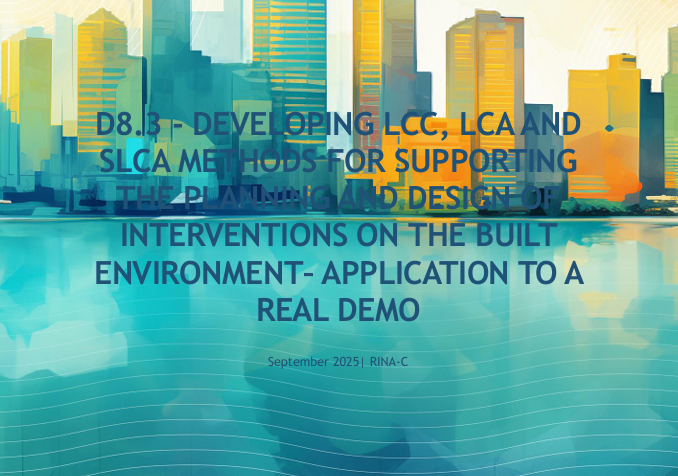
Deliverable D8.3 has been published as a formal MULTICLIMACT output and an important milestone for evidence based decision support. It sets out how the project will assess environmental and social impacts of a real demonstrator intervention using a clear life cycle framework, so replication is based on measured trade offs rather than assumptions.
by Steinbeis Europa Zentrum
MULTICLIMACT has released Deliverable D8.3, “Developing LCC, LCA and sLCA methods for supporting the planning and design of interventions on the built environment, application to a real demo”. The deliverable focuses on life cycle assessment methodology that includes both environmental and social dimensions, developed for application in a real context during the project’s develop and test phase.
The report explains that D8.3 provides cradle to gate life cycle impact assessment methods intended to assess the environmental and social impacts connected to implementing innovative solutions in a historical building in the Latvian demo site, developed by RINA C in collaboration with Riga Energy Agency (REA) and Uponor. It builds on approaches introduced earlier in Deliverable D2.3 and details the key phases of the life cycle approach for MULTICLIMACT use, including parameters and data requirements, and it clarifies that assessment results will be presented later within WP11 and WP15 deliverables as real demo data are collected through the relevant tasks. Deliverable D8.3 introduces the phases and requirements of life cycle assessment for both environmental and social streams, including goal and scope definition, inventory analysis, impact assessment and interpretation, and then focuses on how these methods will be applied to the specific solution planned for the Latvian demo. The deliverable highlights practical building blocks such as system boundaries, data collection checklists, and the identification of risks, assumptions, indicators, modelling tools and reference datasets to ensure the assessment is structured and repeatable. It also specifies that the methodology is intended to assess the implementation of a renewable energy based HVAC solution developed by Uponor for the Latvian demo case, linked to the Riga Central Market context.
D8.3 is led by RINA C with contributions from REA, Uponor, and KTH, and reviewer involvement from KTH, RINA C and UKA, reflecting the mix of assessment expertise and demo site knowledge required for life cycle work that is meant to support real planning decisions.
For full methodological detail and the Latvian demo application framing, read the full deliverable
About MULTICLIMACT:
MULTICLIMACT is an EU-funded project aimed at safeguarding Europe’s built environment against the increasing threats of natural and climatic hazards. By uniting 25 leading European organisations, MULTICLIMACT aims to enhance resilience, sustainability, and safety for communities across the continent. Through innovative strategies, including a toolkit of 20 reliable methods and digital solutions, the project targets the urgent need for adaptive measures against floods, earthquakes, extreme weather conditions and heatwaves. Tested across four pilot sites with diverse climatic conditions, MULTICLIMACT embodies a shared vision for a safer, more resilient future, focusing on actions to reduce the impact of climate change on the built environment. For more information, please visit www.multiclimact.eu


MULTICLIMACT is a Horizon Europe project supported by the European Commission under grant agreement No 101123538. Views and opinions expressed are however those of the author(s) only and do not necessarily reflect those of the European Union. Neither the European Union nor the granting authority can be held responsible for them.
© 2026 MULTICLIMACT Consortium Partners. All rights reserved.