01/10/2025 | News
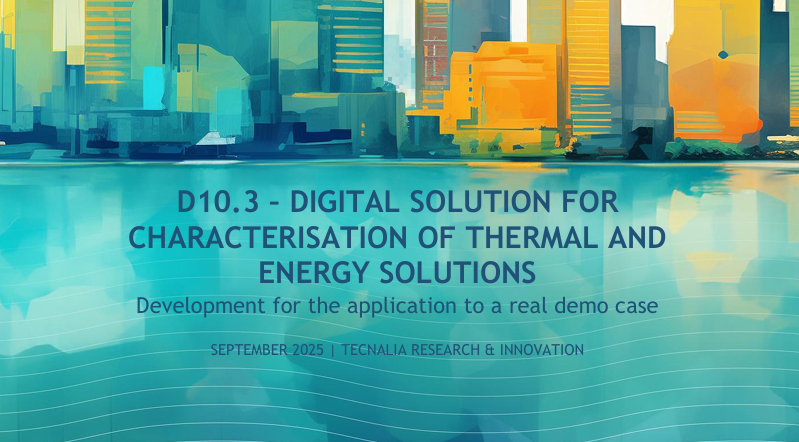
MULTICLIMACT Deliverable D10.3 has been published as both a formal project output and a milestone for how MULTICLIMACT evaluates heat-related interventions in cities. It brings together two complementary digital approaches to understand performance before and after solutions are installed.
by Steinbeis Europa Zentrum
Deliverable D10.3, “Digital solution for characterisation of thermal and energy solutions – development for the application to a real demo case,” presents the final design of two linked digital solutions: a physics-based tool and a data-driven tool for climate-proof characterisation of thermal and energy interventions. The physics-based tool builds on CYPETHERM EPlus (CYPE) and expands modelling to capture interactions between buildings and surrounding pavements within an urban context, using BIM to represent materials and geometry.
The data-driven tool focuses on generating semi-empirical models from monitored data to characterise the in situ performance of pavement solutions, adding a “reality check” to complement design-stage simulations. The deliverable notes that, due to the unavailability of the definitive Spanish demo location at the time, the physics-based validation was carried out using a hypothetical location in Barcelona, while the data-driven validation used monitored data from samples developed and monitored at COMSA’s facilities.
D10.3 is led by TECNALIA, with CYPE responsible for the physics-based tool and TECNALIA leading the data-driven development; Barcelona is involved as the demo site responsible partner, and the deliverable is reviewed by partners including ENEA and RINA-C.
For the full methodology, workflows and results, read the full deliverable here: https://multiclimact.eu/wp-content/uploads/D10.3_draft.pdf
About MULTICLIMACT:
MULTICLIMACT is an EU-funded project aimed at safeguarding Europe’s built environment against the increasing threats of natural and climatic hazards. By uniting 25 leading European organisations, MULTICLIMACT aims to enhance resilience, sustainability, and safety for communities across the continent. Through innovative strategies, including a toolkit of 20 reliable methods and digital solutions, the project targets the urgent need for adaptive measures against floods, earthquakes, extreme weather conditions and heatwaves. Tested across four pilot sites with diverse climatic conditions, MULTICLIMACT embodies a shared vision for a safer, more resilient future, focusing on actions to reduce the impact of climate change on the built environment. For more information, please visit www.multiclimact.eu


MULTICLIMACT is a Horizon Europe project supported by the European Commission under grant agreement No 101123538. Views and opinions expressed are however those of the author(s) only and do not necessarily reflect those of the European Union. Neither the European Union nor the granting authority can be held responsible for them.
© 2026 MULTICLIMACT Consortium Partners. All rights reserved.